
The National do-over
Same suits, new story — and everything National hopes you've forgotten.

National’s 2023 mandate wasn’t a blank cheque. It was a specific, time-bound trust: steady the economic ship, ease the cost of living, govern from a broadly centrist place. Three years later, National is back on the trail asking voters to forget the record and judge them instead on a new set of promises. In a nutshell: they are asking voters for a political do-over.
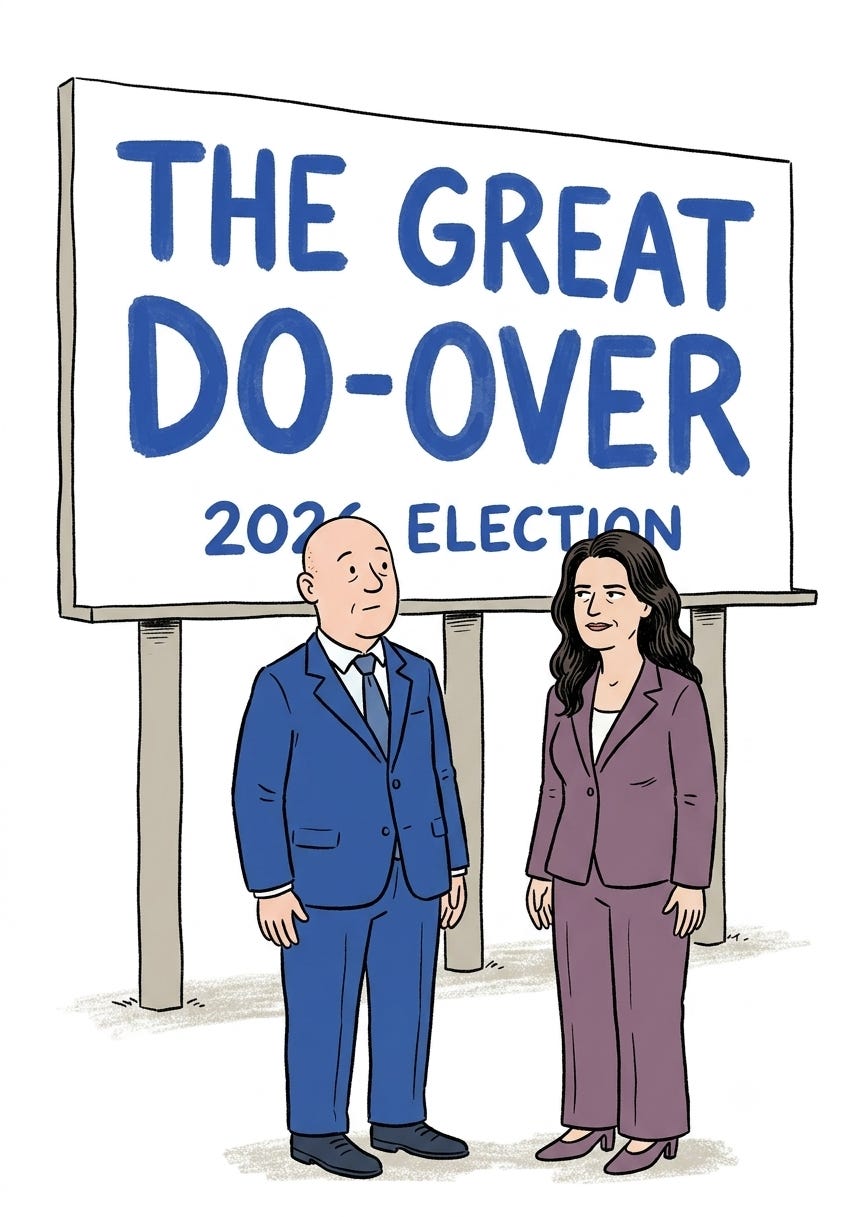
The forgotten mandate of 2023
In 2023, New Zealanders didn’t vote for an ideological revolution. They voted for a change of management. National’s pitch was pragmatic and restrained: fix the basics, restore confidence, bring some relief to households battered by inflation and instability.
That mandate had nothing to do with waging culture wars or relitigating the country’s founding document. It was about rent, groceries, power bills, childcare, wages, and making public services work.
Instead of anchoring the government in centrist economic stewardship, National traded that space away, piece by piece, to satisfy coalition partners with far sharper ideological agendas.
The pivot to culture wars and identity politics
Instead of spending its political capital on productivity and shared prosperity, the government spent much of its term fuelling divisive fights about identity, history, and belonging.
A Treaty Principles Bill, driven by ACT and enabled by National, tried to freeze a narrow, Crown-centric reading of Te Tiriti into law. It failed, but the process itself strained social cohesion and put hard-won understandings of partnership and rights back on the table.
Moves to prioritise English-only branding and pare back te reo Māori in public-sector naming sent a clear message: bilingualism and Māori visibility were now optional extras, not foundational commitments.
In education, “back to basics” rhetoric became a vehicle for rolling back more relational, inclusive approaches to education. A mid-century, three-Rs vision resurfaced, paired with punitive truancy crackdowns and a harder disciplinary tone toward young people.
Trans and gender-diverse communities were repeatedly dragged into the spotlight as ministers flirted with imported culture-war talking points, including signals of support for restricting trans participation in women’s sport. No sweeping legislation was needed to send the message: some identities were now fair game.
None of this delivered cheaper rent, lower grocery bills, or shorter GP wait times. What it delivered was distraction, division, and a clear signal that marginalised communities were expendable in the pursuit of a restive base.
The neoliberal reset of work and welfare
At the same time, the government carried out a quieter but further-reaching reshaping of the economic landscape, one that overwhelmingly favoured employers and capital over workers and communities.
Fair Pay Agreements were repealed, dismantling a framework that would have lifted floor conditions across low-wage sectors.
Ninety-day trial periods were reinstated, tilting the balance of power back toward employers and normalising job insecurity for those with the least bargaining leverage.
The Equal Pay Amendment Act 2025 rewrote the rules of pay equity in ways that effectively wiped existing claims and raised new barriers for future ones. Hundreds of thousands of people (mostly women) in care, education support, and other undervalued sectors watched the legal pathway to redressing historical underpayment narrow overnight.
Thousands of public service roles were cut in the name of “efficiency.” On paper this was about trimming fat; in practice it hollowed out institutional memory, reduced policy capacity, and weakened the very systems that hold inequality in check.
Welfare settings tightened, with a heavier emphasis on sanctions and compliance. Disabled people and their families watched restructures and funding constraints reduce their autonomy and make already complex systems harder to navigate.
This is what it looks like to squander a centrist mandate: instead of building more secure foundations for working people, the government spent its political capital weakening collective protections and re-embedding a harsher, more precarious labour market.
Trading environmental stewardship for short-term growth
The same pattern shows up in environmental policy. The Fast-Track Approvals regime was sold as a modern way to cut red tape and unleash investment. In practice, it concentrated power at the centre, compressed consent processes, and sidelined decades of carefully built environmental safeguards.
Climate policies that had started nudging the economy toward cleaner transport and energy were rolled back or diluted. The Clean Car Discount disappeared. Fossil fuel exploration came back onto the agenda. Once again, long-term, shared interests were traded for short-term corporate gains and a quick GDP headline.
Now: a sudden turn to “centrism” and KiwiSaver
Fast-forward to 2026. With the election four months out, National wants to talk about something else entirely.
The new story is all about “building the future,” fiscal credibility, and a big, bold plan to expand Labour’s KiwiSaver: gradually lifting contributions, aligning with Australian-style settings, promising it will leave everyone better off in the long run.
It’s centrist, technocratic language - encourage private savings, secure long-term fiscal sustainability, give people a stake in the system. It’s also, conveniently, a story with no mention of Te Tiriti, no mention of pay equity, no mention of Fair Pay Agreements, welfare, or the public service. Three years of record, quietly left off the agenda.
Asking for a do-over, not a second term
This is the heart of it.
National isn’t asking for a second term on the strength of a tested record. It’s asking voters to set aside the last three years and judge it instead on a fresh set of promises: trust us this time, we’re serious now about cost of living, stability, the long term.
But politics isn’t a controlled experiment where you get to run three years of culture wars, deregulation, and cuts, then reset the clock and relaunch as a sober economic manager.
You cannot spend a term:
turning Te Tiriti into a wedge,
rolling back worker protections and pay-equity pathways,
tightening welfare and hollowing out public services,
weakening climate protections and fast-tracking environmentally risky projects,
and then ask to be judged as though your tenure began with a KiwiSaver press conference and a glossy brochure.
For families squeezed by rising costs and shrinking supports, for disabled people and carers fighting for basic services, for trans whānau facing rising hostility, for Māori communities defending Te Tiriti, and for the ecosystems absorbing more extraction and less protection, the last three years weren’t an abstraction. They were lived experience.
Memory, accountability, and the ballot box
National took a centrist mandate and spent it on neoliberal restructuring and culture-war politics. Its late-term pivot to KiwiSaver and “stability” is an attempt to rebrand without reckoning.
Elections are about choice. But they’re also about memory. When National seeks endorsement in 2026, it isn’t asking to be judged on its record. It’s asking for a do-over.
Whether voters are willing to grant that is the real question for the 2026 election.
Brilliant piece. And you’ve asked THE question. Will voters let National get away with selling them out and then reselling them again with a do-over? To what….do it all over again? I would say to voters, the old adage still applies, “Fool me once, shame on you; fool me twice, shame on me.”
Indeed. Time to judge them by their track record,not future promises. "Jam tomorrow" doesn't pay today's grocery bills or fuel pump.
While the Nats, Act, and NZFascist were focused on digging up Conservation lands, scrapping pay equity, promoting fossil fuel extraction, and policing peoples' genitalia, the rest of us were busy coping with day to day challenges.
This was a govt off the reigns on an ideological rampage.
Many of us won't forget.