
One last question, Barry
About the imposter that never was

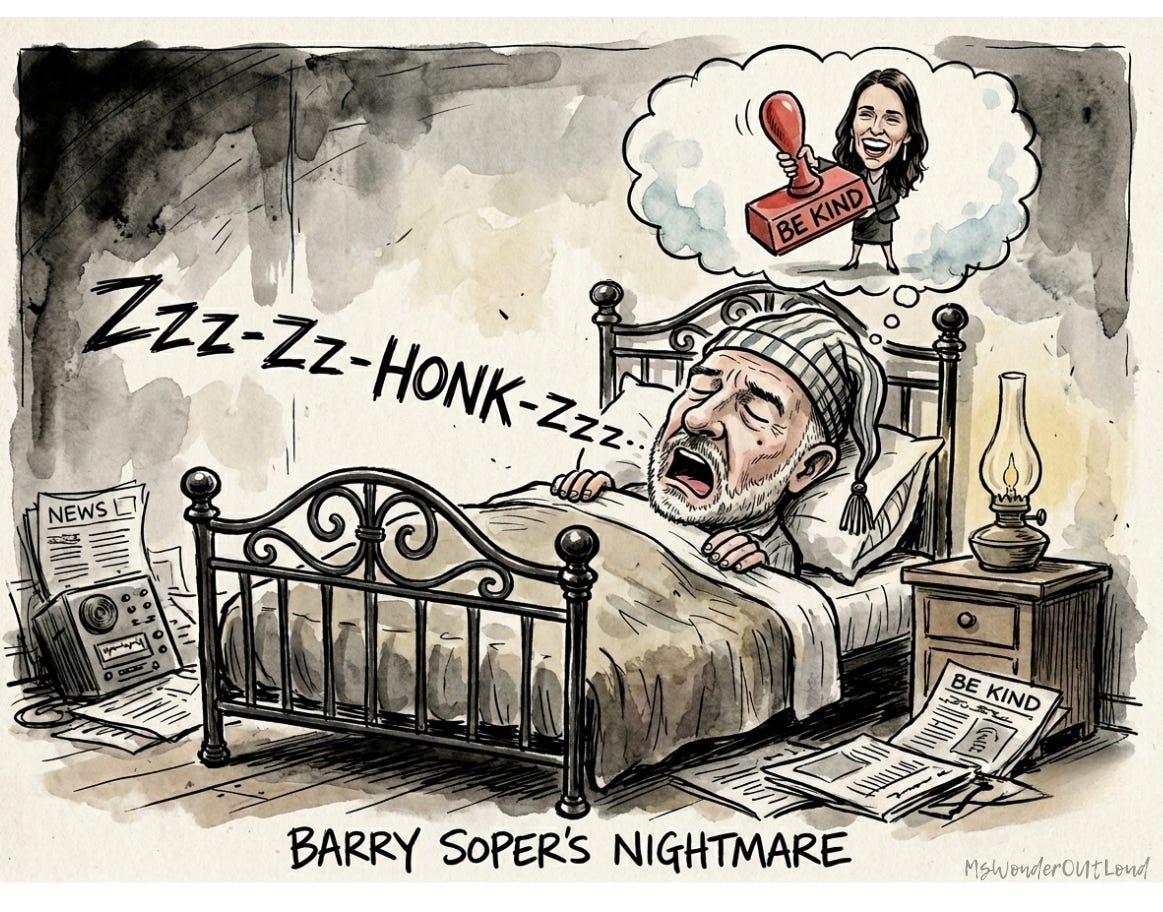
Barry Soper wrote a memoir. A memoir about his working life as a political reporter - a career measured in twelve Prime Ministers, from the larger-than-life characters of Muldoon and Lange, through what he calls the golden age of Clark and Key, to the post-Covid era of Ardern and Luxon.
Twelve Prime Ministers. And somehow, three years later, one of them is still living rent-free in his head.
We are still here. Still doing this. In 2026.
I won’t be reading One Last Question, Prime Minister. I tend to avoid books that prioritise ego over evidence — books written by men who hold views that should have been left behind in the 1970s. But sadly I didn’t need all 300 pages to understand the verdict Soper is trying to cement in the historical record. The extracts — and the one word he reaches for in his interview with Audrey Young — tell me everything I need to know.
After twelve Prime Ministers and three years of sitting with it, Barry Soper — like a lead role in Mindhunter — has profiled Jacinda Ardern and found his label.
That word is imposter.
It’s a fascinating choice. Precise-sounding. Forensic. In its literal sense, an imposter is someone who fabricates an identity for gain — not someone who doubts themselves, but someone actively deceiving others about who they are. Soper knows this. He’s a senior journalist. He chose it deliberately.
And he brings evidence. All of it viewed entirely through the lens of how she made him feel, in his role as political journalist. She organised slick, orderly media briefings that she front-footed — always sober, which frankly raises its own questions about her character. She made reporters raise their hands. She had the audacity to let young female journalists ask questions before Barry got his turn. She limited his follow-ups. She gave more women a chance at the microphone. And then there was the small matter that she never once invited him up to the ninth floor for a beer. How is a man supposed to tell good stories when he never heard her slur her words?
That’s it. That’s the case.
Compelling. And it is on this piece of compelling evidence that Barry boldly declares that the reason Jacinda Ardern suffered from imposter syndrome is because she is one. (Projecting much, Barry?)
There is that old wisdom — people will forget what you said, people will forget what you did, but people will never forget how you made them feel. Clearly Jacinda Ardern made Barry Soper feel like he wasn’t the most important person in the room. And he is bitter about that.
But here is where I wonder if Mr Soper might be suffering from the same affliction. Because how can a man of his his considerable self-estimation call Jacinda Ardern an imposter — because her press conferences were just too slick — while Robert Muldoon, literally drunk on the job while making constitutional decisions, is just a “character” with a colourful political career?
How can Soper question whether Ardern stepping out to breastfeed her daughter makes her unfit for the role — while defending Christopher Luxon as a “corporate high-flyer” who will “get good... one day... maybe”?
That’s not analysis. That’s a values system on full display. One that should have been left behind fifty years ago.
And then there is the tired old kindness trope. Because of course there is.
Soper is aggrieved that her policies didn’t live up to her “kindness” rhetoric. As a comms man, I would have thought Barry understood the difference between a communications frame and a policy guarantee. Critiquing every subsequent decision through that metric is like holding a road-safety campaign personally responsible for every accident.
My four-year-old great-niece is quick to remind people around her “that’s not kiiind” when they displease her. It’s very cute in a four-year-old. In a veteran political journalist, less so.
But it’s not all bitterness.
Soper does have one fond recollection of Ardern — asking her “respectfully” if he could touch her stomach when she was heavily pregnant with Neve. Ardern replied, “Of course, Barry.” He has a photo. He describes it as “wonderful.”
To him: warmth. Professional intimacy. Access.
To me and most women I know: the ultimate cringe.
Imagine Tova O’Brien asking if she could run her hand over Christopher Luxon’s smooth bald head.
What that moment reveals is a culture of entitlement — where professional boundaries were optional for men who considered themselves intimates of power. What it tells me about Jacinda Ardern is that she was full of grace. More grace than I would have mustered. And now he’s written a book calling her a fraud.
Right.
The story behind the story.
Barry Soper didn’t get invited to the ninth floor for a beer. He had to raise his hand. He couldn’t always get the follow-up. He learned what he considers real politics over scotch with Muldoon — and somewhere in his career, that became the standard everything else gets measured against.
Ardern didn’t fit that world. She didn’t drink with him, didn’t let him set the terms of engagement, didn’t perform the deference the Old Boys Club had come to expect. She ran a tighter operation and he never forgave her for it. And for that, Barry calls her an imposter.
That’s not a verdict on her fitness for office. It’s a portrait of an old man yearning for a time when the ninth floor came with a beer, the press gallery came with deference, and women had the good grace to stay grateful.
Is there a typo here? I thought his name was Sober, Barely Sober?
I remember one very sharp rebuke of Soper by JA during the 1pm covid update on tv. He whined about having a deadline to meet as Ardern took questions from other journalists. She just politely said “so does everyone else” and took another question from a female journalist…without a pause in her thoughts. He clearly thought he was the most important journalist there and got relegated to the corner. The cartoon is perfect. Heather will probably try to boost her ratings by waxing lyrical about the book on her radio show.